
ExtremaduraCáceres
Cáceres: the walled town and the cheese of Casar
A walled quarter of stone towers and palaces in Extremadura, storks nesting on every belfry, and a few kilometres north, a sheep's cheese so soft you eat it with a spoon.
The dish: Torta del Casar on bread
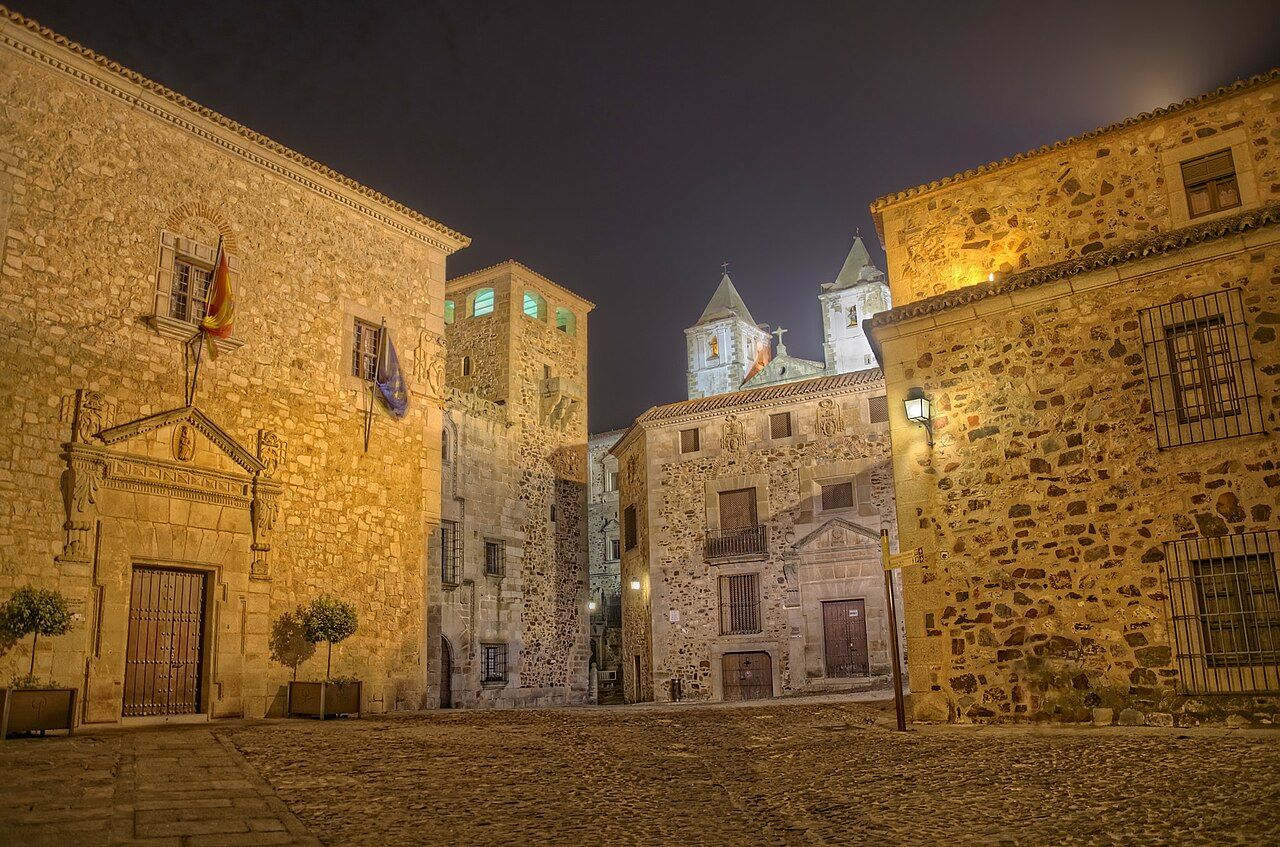
Cáceres is a city in Extremadura, in the west of Spain near the Portuguese border, a dry, hot land of oak pasture, sheep and pigs. At its heart is a walled medieval town of stone towers, palaces and churches, so complete that it has been a World Heritage Site since 1986. It is quiet, especially in the evening, when the stone glows and the storks clatter on the belfries. Its food is the food of the dehesa: ham, lamb, migas, and one of the great cheeses of Spain.
The walled town
The old town, the ciudad monumental, sits on a low hill above the newer city. Its walls were built largely by the Almohads, the Moorish rulers of the twelfth century, on older Roman foundations, and many of their square towers survive. The main entrance from the Plaza Mayor is the Arco de la Estrella, an eighteenth-century gateway set at an angle in the walls. Next to it stands the Torre de Bujaco, one of the Almohad towers.
Inside the walls, the streets are narrow and paved with stone, and almost every building is old. After the Christian conquest in 1229, noble families built fortified houses here, each with its own tower. Their rivalries were fierce, and in the fifteenth century Queen Isabella ordered the towers to be cut down; only one or two were spared. You can still see the stumps of many of them.
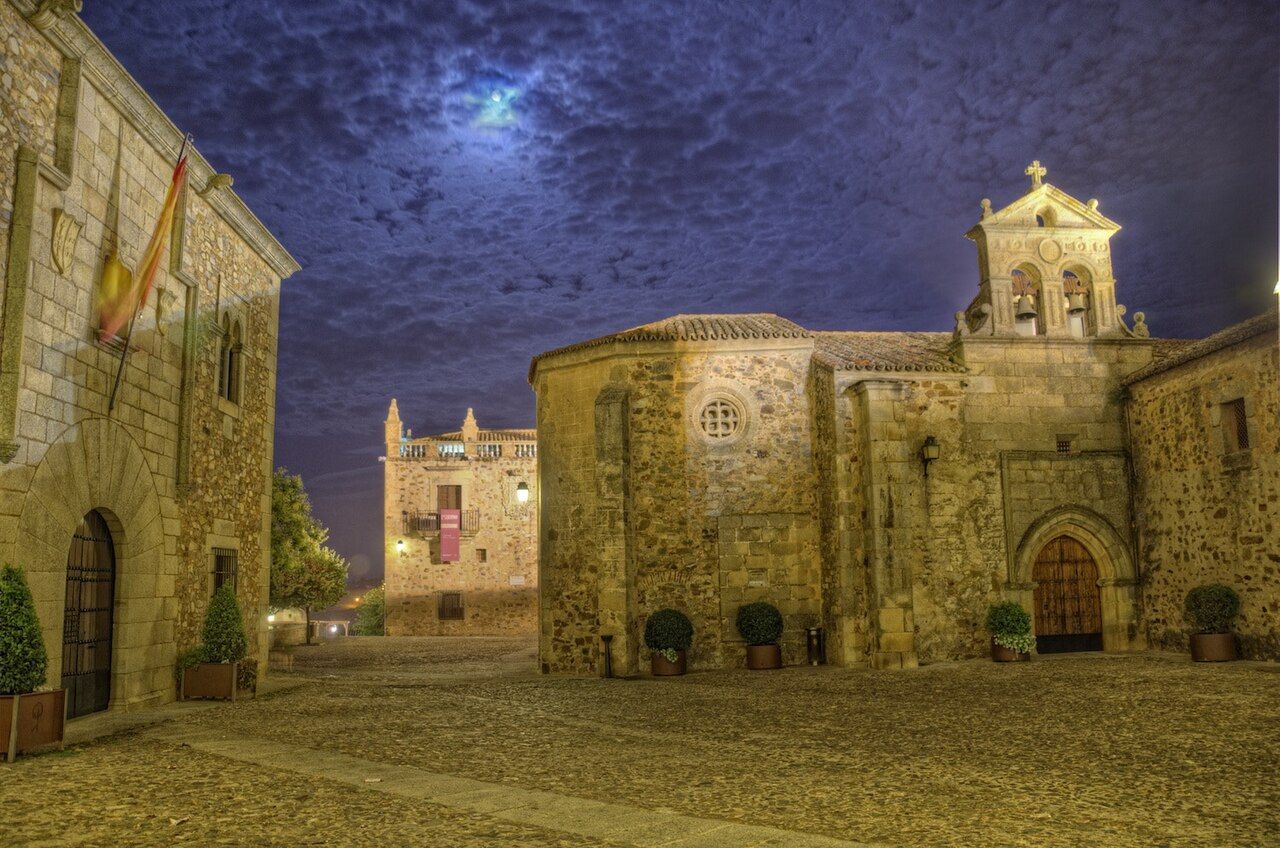
Walk the old town at different times of day. In the morning, the light is soft and the streets are empty. At midday in summer, the heat is serious, and most people stay indoors. In the evening, the stone turns gold, and at night the old town is lit and very quiet.
Palaces, churches and towers
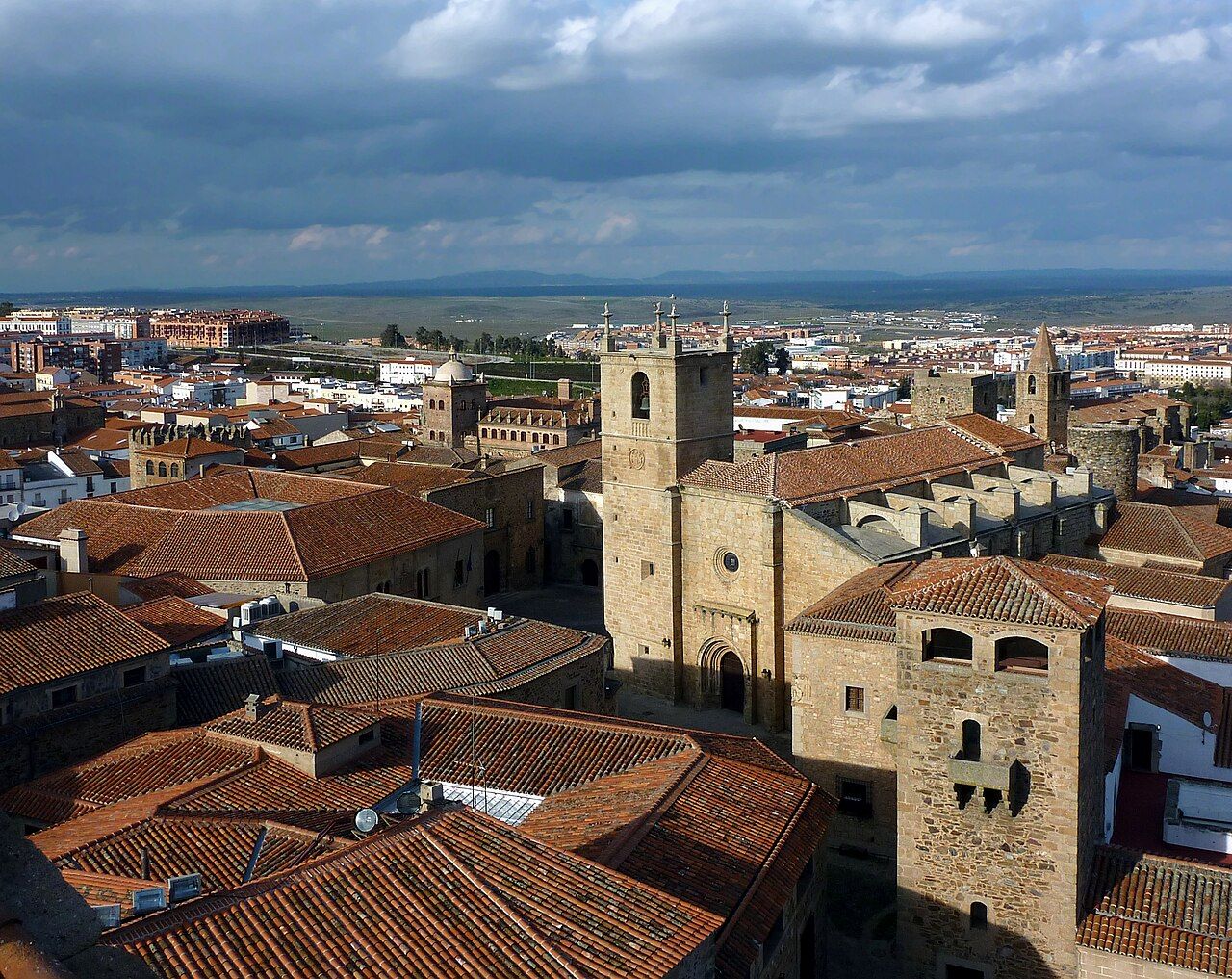
The concathedral of Santa María, mostly Gothic, stands on its own square among the palaces of the nobility. Climb its tower if it is open for a view over the rooftops. The Palacio de los Golfines de Abajo has a fine Plateresque façade. The Casa de las Veletas holds the Museo de Cáceres, with archaeology and art, and below it a Moorish cistern, or aljibe, with horseshoe arches reflected in still water.
The Plaza de San Jorge, at a lower level, is dominated by the white Baroque façade and twin towers of the church of San Francisco Javier, built by the Jesuits in the eighteenth century. From the plaza, steps lead up into the heart of the old town.
The storks are everywhere. They nest on the towers, belfries and rooftops of the old town, building huge nests of sticks, and they arrive in large numbers from about late winter. Their clattering beaks are the sound of the town in spring. Many now stay through the year.
A detour: ExtremaduraTrujillo and the dehesa, where the ham beginsBelow the walls, the Plaza Mayor is the meeting point between the old town and the newer city. It is a long, sloping square lined with arcades, with the walls and the Torre de Bujaco along its upper side. Its terraces fill in the evening, and it is the natural place to start and end a walk. From here, streets of shops and houses lead down into the modern town, where most people in Cáceres actually live, eat and go out.
Leave time to walk the outside of the walls as well as the inside. The path around the base of the old town shows how the city was defended, with the towers set at intervals along the line of the walls and the houses built up against them. In places the palaces rise directly above the old defences, their windows cut into what was once a blank military wall.
The old Jewish quarter
On the eastern edge of the old town, around the hermitage of San Antonio, lies the old Jewish quarter, the judería. The streets here are narrower and steeper, with whitewashed houses rather than stone palaces. A Jewish community lived here until the expulsion of 1492; the hermitage is thought to stand on the site of the former synagogue. It is a quiet corner, away from the main sights.
Torta del Casar and the table
A few kilometres north of Cáceres is the village of Casar de Cáceres, which gives its name to one of the great cheeses of Spain: Torta del Casar, a protected designation. It is made from the raw milk of Merino and Entrefino sheep, and the milk is curdled not with animal rennet but with the dried flowers of a wild thistle, Cynara cardunculus. The thistle gives the cheese a slightly bitter, vegetal flavour.
When ripe, the inside is so soft that it runs.
The cheese is shaped into a flat round and aged for some weeks. As it ages, the rind firms and the inside softens. When ripe, the inside is so soft that it runs. To eat it, you cut a lid off the top of the round and scoop out the cheese with a spoon or bread, as you would a dip. The taste is rich, creamy, salty and slightly bitter, very intense. A round is shared among several people, with bread and a glass of red wine. You can buy it in the city and at the village.
The rest of the table is the food of the dehesa: acorn-fed Iberian ham and other cured pork, roast and stewed lamb in a caldereta, migas extremeñas of fried bread with pork and peppers, and dishes seasoned with the smoked paprika of the Vera valley, pimentón de la Vera, another protected product of the region. The story of the acorn-fed pigs and the dehesa is in Trujillo and the dehesa, an easy drive east.
Extremadura also makes wine. The Ribera del Guadiana appellation covers vineyards in the south of the region, and the reds are a good partner for the cheese and ham.
Lunch begins from about 2 pm and runs late. Many places close one day a week. In summer, people eat late in the evening, when the air cools.
Getting there
Cáceres is about three and a half hours from Madrid by car on the motorway, and trains run from Madrid. It is also close to Mérida and its Roman theatre, about an hour south, and to the border of Portugal, with Marvão on its granite ridge not far to the west. The old town is closed to most traffic; park outside the walls and walk.
The best time to come is spring, when the dehesa is green and full of flowers and the storks are nesting, or autumn. Summer days are very hot. Winter is mild by day but cold at night.