
ExtremaduraMérida
Mérida's Roman stones
Emerita Augusta survives in pieces all over a working Extremaduran town: a theatre that still plays each summer, a bridge you can walk, and lamb stewed slowly for a late lunch.
The dish: Caldereta of lamb
Few towns in Spain wear their Roman past as casually as Mérida. The capital of Extremadura is a modest, busy place of offices, schools and apartment blocks, and among them, sometimes in a gap between two ordinary buildings, sit the stones of Emerita Augusta: a temple's columns, a stretch of paved road, the floor of a house with its mosaics still in place. The colony was founded in 25 BC for veteran soldiers, the emeriti, of Augustus's wars in the north, and it grew into the capital of Lusitania, a province that covered much of what is now Portugal. You come for the monuments. You stay for the long lunch after them, because the plain around Mérida feeds a kitchen built on lamb, pork, bread and olive oil.
The theatre and the amphitheatre
The Roman theatre is the reason most people make the trip, and it earns it. Built in the last decades before Christ, it has a half-circle of stone seating facing a tall stage front of two storeys of marble columns, with statues set between them. Much of that stage front was pieced back together in the twentieth century from fallen fragments, and you can see the joins if you look closely, but the effect is still close to what a Roman audience saw: a wall of architecture behind the actors and open sky above.
Next door is the amphitheatre, where gladiators fought and animals were hunted for show. It is plainer and more ruined, an oval of worn tiers around a sunken arena, with the pit beneath the floor still open. The walk from one to the other takes a couple of minutes, and the contrast says something about Roman taste: drama on one side, blood sport on the other, both paid for by the same town.
The theatre still works. Every summer Mérida holds a festival of classical theatre in it, a tradition that goes back to the 1930s, with Greek and Roman plays and modern pieces drawn from them performed at night once the heat has gone. Dates and programmes change each year, so check before you go, and take something soft to sit on: the stone holds the day's warmth and grows hard after an hour.
The bridge over the Guadiana
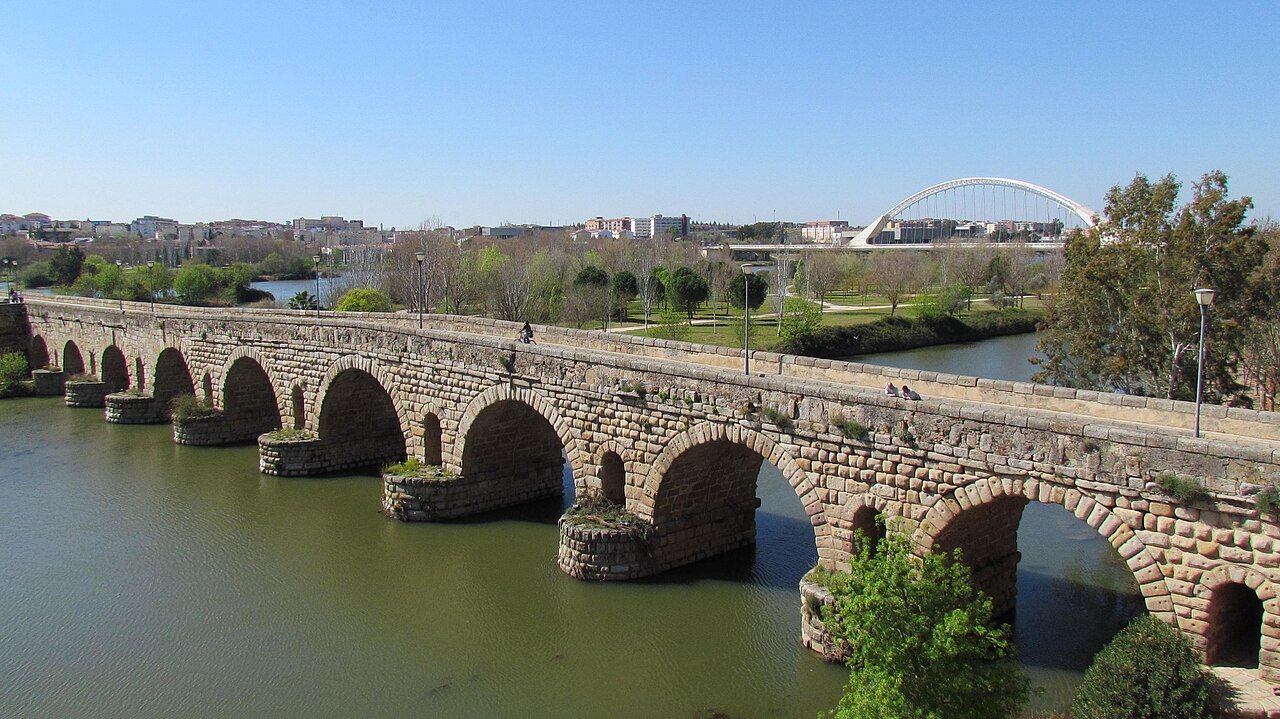
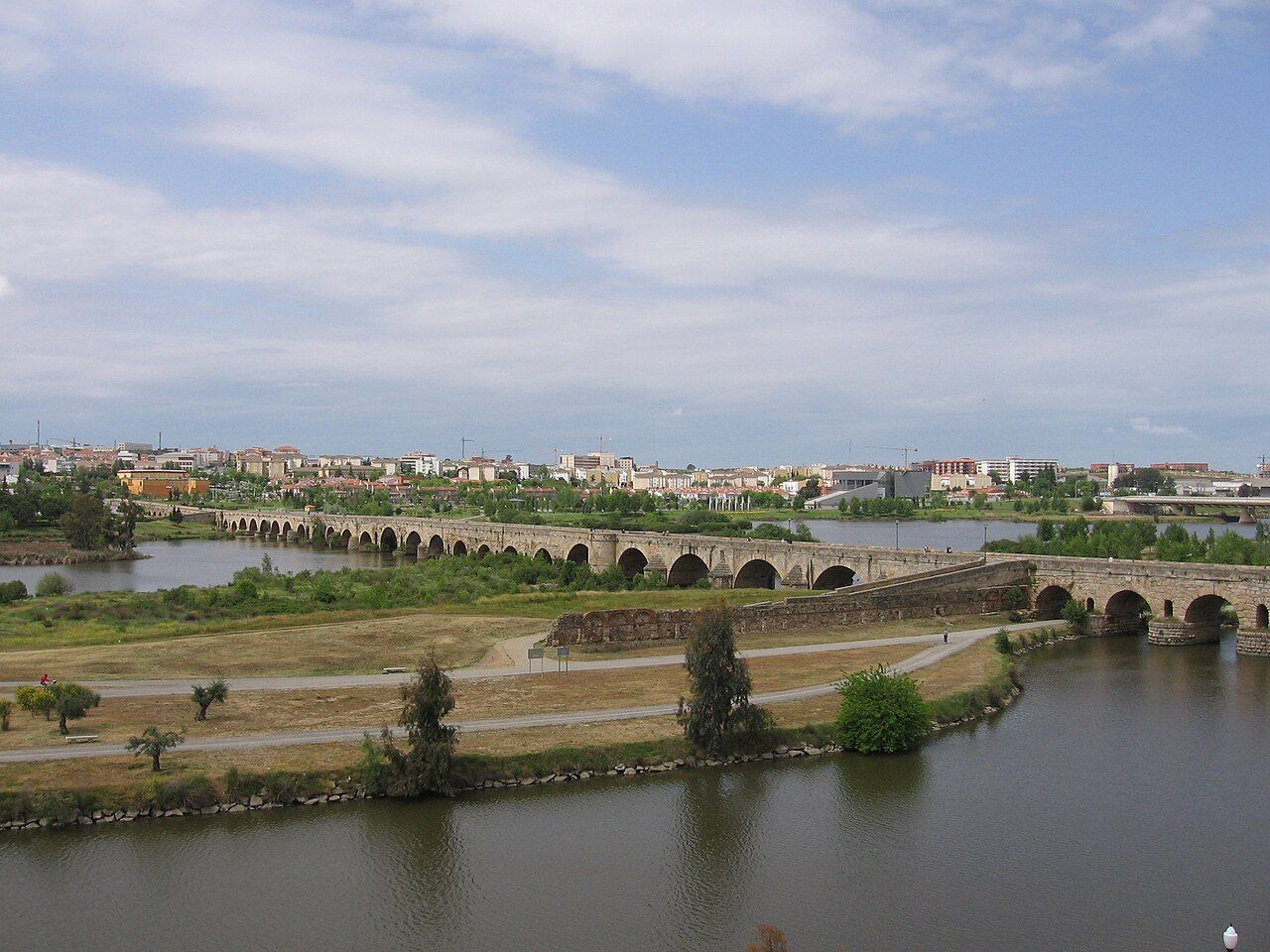
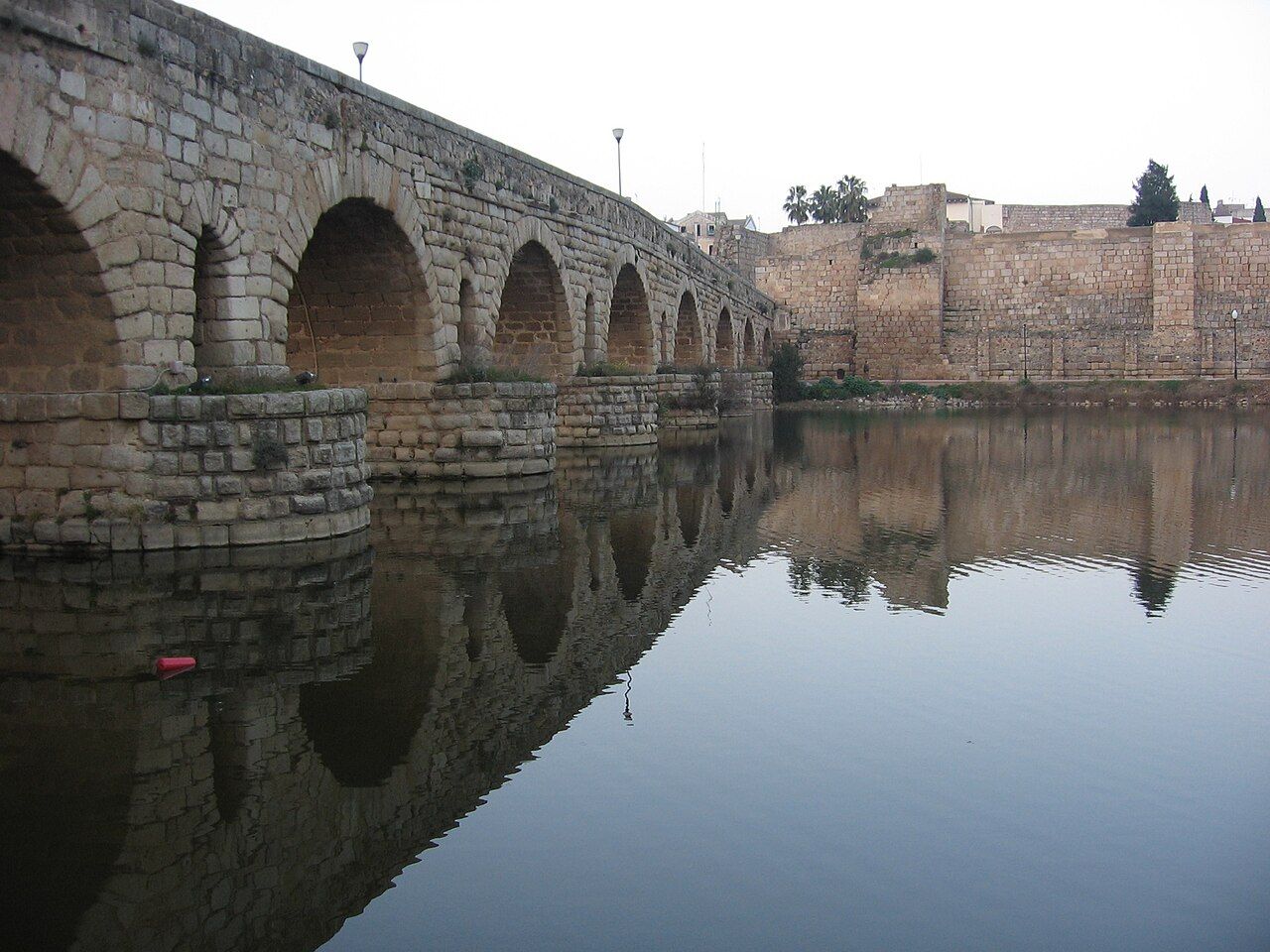
The Puente Romano crosses the Guadiana on dozens of granite arches and runs for roughly 800 metres, which makes it one of the longest bridges to survive from the Roman world. It carried traffic for most of two thousand years, patched and rebuilt after floods and wars, and was closed to cars only after newer bridges went up in the late twentieth century, among them the white arch you see downstream. Now it is a footpath, and crossing it at the end of the day, with the river slow and green below and swallows working the arches, is one of the plainest pleasures in Extremadura.
At the town end of the bridge stands the Alcazaba, a square fortress with thick walls built in the ninth century by the emirs of Córdoba to hold the crossing. Inside, a stairway leads down to a cistern fed by the river, built with reused Roman and Visigothic stone. The fortress is a reminder that Mérida did not stop with Rome: it was a Visigothic city and then an Islamic one before Christian armies took it in the thirteenth century.
The museum and the scattered sites
The National Museum of Roman Art is the best single building in Mérida for making sense of what you have seen outside. It is a modern brick structure of tall arches, built to echo Roman construction, and it stands over the remains of Roman streets, which you can walk among in the basement. The main hall holds statues from the theatre, portrait heads, coins, tombstones and floor mosaics hung on the walls like great rugs. An hour here before the theatre turns the ruins from stone into a town.
A detour: At the tableVentas, posadas and the old inns of the Iberian roadsElsewhere the Roman town turns up in fragments. The temple usually called the Temple of Diana, though it was more likely dedicated to the cult of the emperor, still has its columns standing in a small square in the centre. The aqueduct known as Los Milagros strides across a valley on the north side of town on tall piers of granite and brick, with storks nesting on the top. There are remains of a circus for chariot races, a Roman house with painted walls and mosaics, and a little arch over a street. A combined ticket covering several sites has long been offered; prices and hours change, so check before you go.
What to eat in Mérida
Extremadura cooks for people who work outdoors, and Mérida's tables show it. The dish to look for is caldereta of lamb: pieces of lamb browned in olive oil and stewed slowly in a pot with garlic, peppers, bay and paprika, sometimes thickened with the lamb's liver pounded into the sauce. It comes to the table dark and rich, with bread to mop it up. In colder months you also find migas extremeñas, day-old bread cut small, dampened and fried in olive oil with garlic, chorizo and pork belly, a shepherds' dish now eaten as a starter or a weekend breakfast.
The province's cheeses and hams are close by. The soft, spoonable sheep's cheese of Casar comes from the country north of Cáceres, and the acorn-fed Iberian ham of the region is cured from pigs raised in the oak pasture you will cross on any road out of town, the same dehesa around Trujillo where the montanera season runs roughly from autumn into winter. Smoked paprika from the Vera valley, in the north of Extremadura, colours a great deal of what you eat. The local wine is from the Ribera del Guadiana appellation, mostly sturdy reds that suit the lamb.
Lunch in Mérida runs late, often from about 2 pm, and in summer the town goes quiet in the afternoon, with many places closed until evening. Many kitchens also close one day a week, so do not leave your main meal to chance on a Sunday or Monday.
Roads in and out
Mérida was a road town before it was anything else. The Roman route later called the Vía de la Plata ran north from here through Cáceres to Salamanca and on to Astorga, and drovers, traders and later pilgrims walking to Santiago followed it for centuries. The modern A-66 motorway runs roughly along the same line. West, the road runs to Badajoz and the Portuguese frontier, and from there Évora and the Alentejo plain are an easy morning's drive further on. Madrid is half a day east on the A-5.
In summer, Mérida is one of the hottest towns in Spain. Visit the outdoor sites in the first hours of the morning, retreat to the museum at midday, and come back to the bridge after dark. Spring and autumn are kinder for walking, and the light on the granite in late afternoon is worth waiting for.