
ExtremaduraTrujillo
Trujillo and the dehesa, where the ham begins
A granite hill town that sent its sons to the Americas, a square built on what they brought back, and around it the oak pasture where Spain's finest ham starts life.
The dish: Acorn-fed Iberian ham
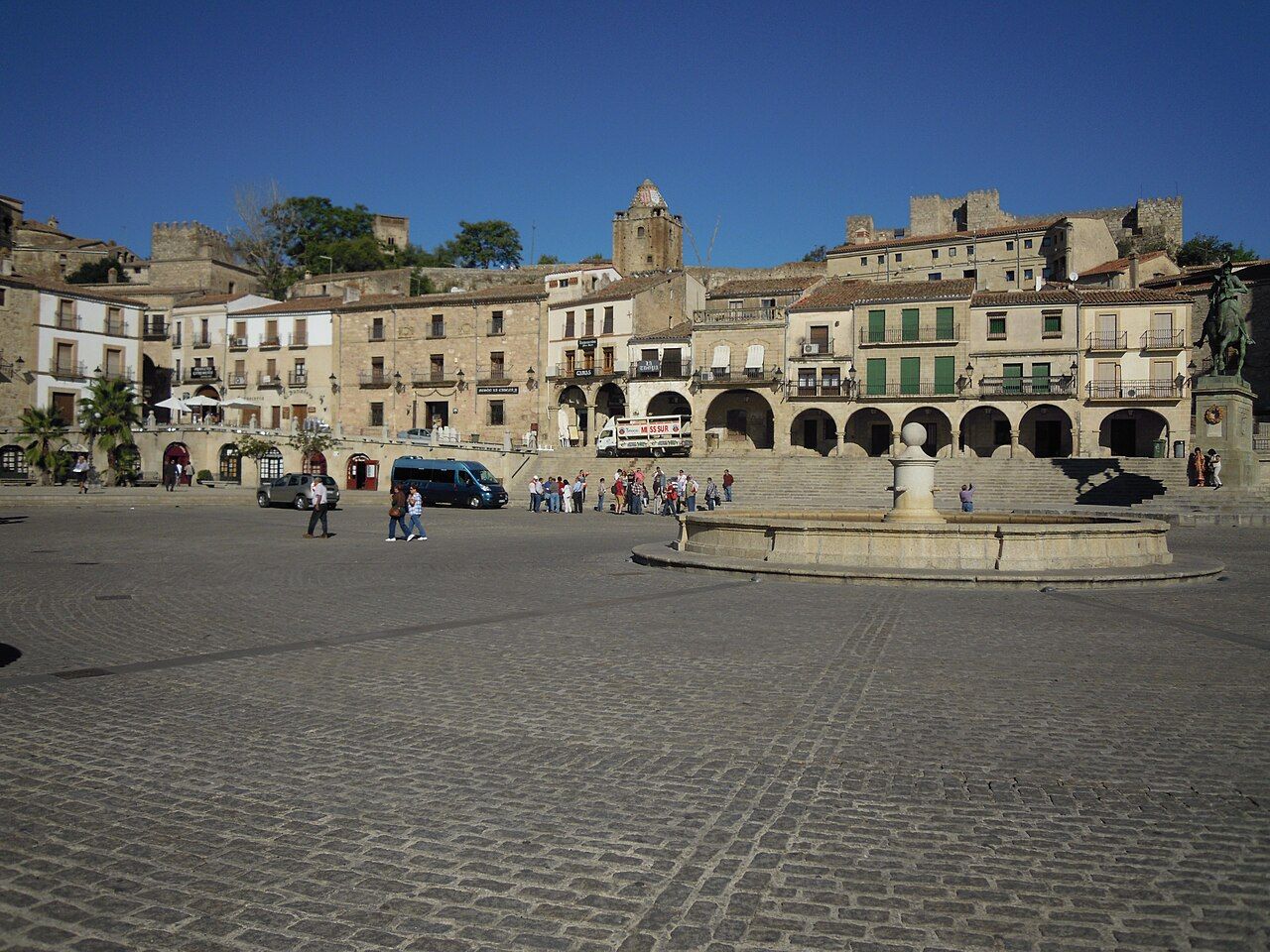
Trujillo sits on a granite ridge above a plain of scattered oaks, and from the motorway you see it long before you reach it: a castle along the crest, church towers below, and the roofs stepping down the slope to a great open square. It is a small town with a large history. Several of the men who went to the Americas in the sixteenth century came from here, and some came back rich enough to build palaces. Around the town lies the dehesa, the managed oak pasture of Extremadura, and in that pasture, every autumn and winter, the black Iberian pigs eat the acorns that become the region's most prized ham.
The square the conquistadors built
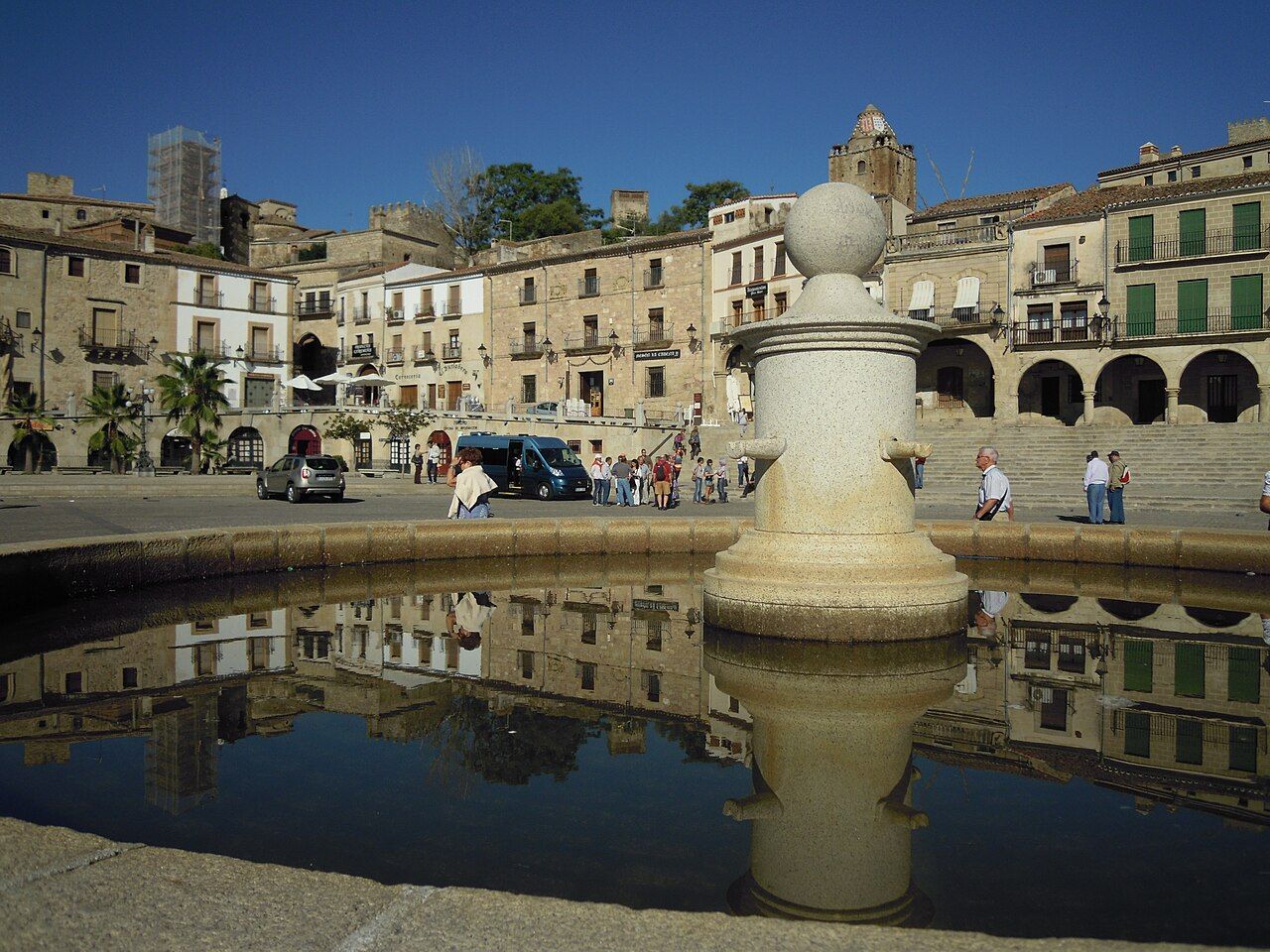
The Plaza Mayor is the heart of Trujillo and one of the great town squares of Spain. It is not a regular rectangle closed on four sides, like the squares of Salamanca or Madrid. It is irregular and open, set on a slope, with flights of granite steps rising to the church of San Martín at one corner and arcades running along the lower sides. Palaces of noble families line the edges, many of them built or enlarged with wealth from the Americas.
The most famous son of the town is Francisco Pizarro, who led the Spanish conquest of the Inca empire in Peru. A bronze equestrian statue of him, in helmet and armour, stands at the top of the square, set apart from the arcades. Francisco de Orellana, the first European to travel the length of the Amazon, was also born in Trujillo. Their story is not a gentle one, and the town tells it with more pride than most outsiders feel, but it is impossible to understand Trujillo without it.
Look for the Palacio de la Conquista, a palace built for the Pizarro family, with a carved corner balcony decorated with coats of arms and stone busts. Corner balconies like this one are a feature of the town, placed so that the family could look down two streets at once. Many of the palaces are still private houses, so you see them from the street.
The square is best in the early morning, before the day trippers arrive, or in the evening, when the granite gives back the day's warmth and people come out to sit on the steps. Storks nest on the towers and belfries for much of the year, clattering their beaks overhead.
Up to the castle
From the square, the lanes climb steeply through the walled upper town, the oldest part of Trujillo. The streets are narrow and cobbled, the houses built of the same rough granite as the hill, and many are now empty, which gives the upper town a quiet, slightly abandoned feel. On the way you pass the church of Santa María la Mayor, older than San Martín, with a Romanesque tower and a Gothic interior. You can usually climb the tower for a view over the roofs; hours change, so check before you go.
At the top stands the castle, a fortress begun in the Islamic period and later rebuilt and extended by the Christian kingdoms after the Reconquista. Its walls and towers enclose an open courtyard and give long views in every direction. From up here you see the shape of the land: the town falling away below, and beyond it the flat country of granite boulders, pasture and oaks running to the horizon. That landscape is the reason for the second half of this story.
A detour: ExtremaduraMérida's Roman stonesWhat the dehesa is
The dehesa is a working landscape, not a wild one. It is pasture dotted with holm oaks and cork oaks, thinned over centuries so that the trees stand well apart, each with a broad crown and grass beneath. Farmers prune the oaks to increase the acorn crop, graze cattle, sheep and pigs among them, and sometimes sow cereals between the trees. Cork is stripped from the cork oaks every several years, and the wood from pruning was traditionally burned for charcoal.
The result is a kind of open savanna that covers large parts of Extremadura, western Andalusia, the south of Salamanca province around Guijuelo and, across the border, the Alentejo. It looks natural, but it depends on people. Left alone, it would close up into scrub and woodland; overused, it would lose its trees. A healthy dehesa supports cranes in winter, vultures and eagles, and a great deal else besides.
From Trujillo, the back roads in any direction take you through it. The road north towards the Tagus and the national park of Monfragüe crosses some of the finest stretches, especially in late spring, when the grass is green and the ground is full of flowers.
The pig and the montanera
The animal at the centre of the dehesa economy is the Iberian pig, cerdo ibérico, an old breed with dark skin, thin legs and a long snout. Its black hooves give one of its nicknames, pata negra. It has a remarkable ability to lay down fat within the muscle, which is what gives the cured ham its marbling and soft texture.
The key season is the montanera, which runs roughly from late autumn into the end of winter, when the acorns ripen and fall. Pigs that are ready for it are turned out into the dehesa and left to roam, eating acorns and grass and walking long distances each day. Over those months they put on a great deal of weight, much of it from the acorns alone. The oleic fat of the acorn passes into the meat, and the walking builds muscle.
The oleic fat of the acorn passes into the meat, and the walking builds muscle.
Only pigs fattened this way, on acorns and pasture in the montanera, can be sold as de bellota, acorn-fed. Pigs fed partly or wholly on grain are sold under other grades. Spain's rules for Iberian pork use coloured labels on the hams: black for acorn-fed pigs of pure Iberian breed, red for acorn-fed pigs of mixed breed, green for pigs raised outdoors on pasture and feed, and white for those raised on feed. The black label is the one to look for if you want the full expression of the dehesa.
From leg to ham
After the montanera comes the curing. The legs are salted, then rested, then hung to dry in airy rooms where the changing seasons do part of the work, and finally aged in cool cellars. For the best acorn-fed hams the whole process often takes two years or more. The Dehesa de Extremadura appellation covers hams cured in the region, alongside the better-known Jamón de Guijuelo to the north and the hams of Jabugo and Los Pedroches to the south.
Eating it, and the rest of the table
A plate of acorn-fed ham should be cut by hand, in thin, small slices, each with a little fat at the edge. Serve it at room temperature, never cold from the fridge, so that the fat turns translucent and starts to glisten. It needs nothing but bread. In Trujillo, ham appears at the start of almost every meal, along with lomo, the cured loin, and chorizo and salchichón from the same pigs.
The rest of the local table follows the dehesa too. Fresh Iberian pork, especially the cuts called presa and secreto, is grilled and served pink in the middle. Migas extremeñas are breadcrumbs fried with garlic, peppers and pork. Lamb stew, caldereta, is made with the sheep of the same pastures, and smoked paprika from the Vera valley colours much of the cooking. The soft, runny sheep's cheese from Casar, near Cáceres turns up at most tables, and Trujillo holds a well-known cheese fair, usually in spring; dates change, so check before you go.
To drink, the local wines are those of the Ribera del Guadiana, from the vineyards around Badajoz and the Tierra de Barros. A cool white or a young red works well with ham. Lunch, as across Spain, starts late, often from about 2 pm, and in summer the town stops completely through the heat of the afternoon.
When to come and how to move around
Trujillo lies beside the main motorway west from Madrid towards Badajoz and Lisbon, which follows the line of the old royal road to Portugal; travellers on that road once stopped at the ventas and posadas along it. Buses run from Madrid and Cáceres. A car is the best way to see the dehesa, since the pastures lie along minor roads with little public transport.
The best months are autumn and spring. From roughly October into winter the montanera is under way, and you can see pigs foraging under the oaks from the roadside, though the farms themselves are private land; some offer visits by arrangement. Spring brings green grass and flowers. Summer is hot, often very hot, and the dehesa turns gold and dry. Combine Trujillo with Cáceres, a short drive west, and with Roman Mérida further south, or cross the border to Évora and the Alentejo, where the same oaks and pigs continue.