
At the tableSpain and Portugal
Ventas, posadas and the old inns of the Iberian roads
Before railways and motorways, the interior was crossed at the pace of a mule, and every night ended at an inn: a lonely venta on the plain or a posada with a courtyard in town.
The dish: Migas, the carters' fried bread
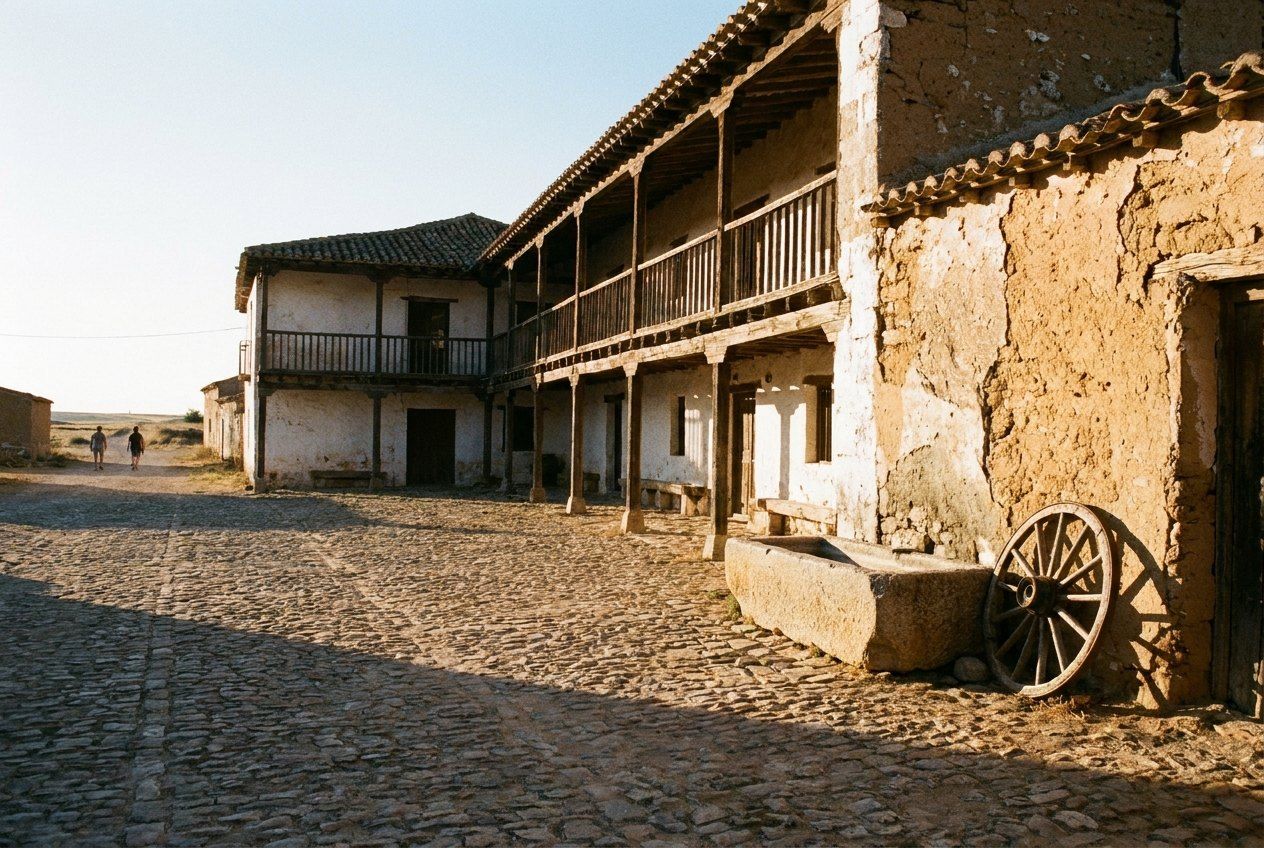
For most of their history, the roads of inland Spain and Portugal were travelled slowly. Goods moved on the backs of mules or in ox carts, people walked or rode, and a journey from Madrid to the coast took many days. Each of those days ended at an inn. The words for those inns, venta, posada, mesón and fonda, are still in use, and the buildings that survive explain a good deal about how the interior lived, travelled and ate.
Venta and posada
The two main kinds of inn were defined by where they stood. A venta stood alone on the open road, between towns, often at a crossroads, a river crossing or the foot of a pass, wherever travellers needed to stop. It was a working stop for carters, muleteers and anyone caught on the road at nightfall. A posada stood inside a town or village, usually near the gate or on the main street, and took in travellers who had reached somewhere.
The buildings had a common pattern. A wide gateway, big enough for a loaded cart, opened onto a courtyard with a well or a stone trough. Around the courtyard ran stables and storerooms on the ground floor, and above them a wooden gallery gave access to the rooms. The kitchen, with its open hearth, was the centre of the house: it was where travellers warmed themselves, cooked and ate, and often where the poorer ones slept. Animals usually came first. A muleteer's living depended on his mules, and the stable mattered as much as the bed.
In Portugal the equivalent words were estalagem and albergaria for an inn, and venda for a roadside shop that often also sold food and drink. The pattern of courtyard, stable and hearth was much the same on both sides of the border.
Mule trains and the royal roads
The people who filled these inns were mostly working travellers. The arrieros, muleteers, drove trains of mules loaded with wine, oil, wool, salt, grain and cloth between the towns of the interior and the ports. The carreteros moved heavier loads in ox carts. Shepherds followed the drove roads, the cañadas, moving huge flocks of sheep between summer and winter pastures, a system organised for centuries by the powerful shepherds' guild of the Mesta.
The main routes were known as the Camino Real, the royal road, a name given to the principal roads under the crown's protection. For a long time many of them were little more than tracks, dusty in summer and deep in mud in winter. In the eighteenth century the Bourbon kings began a programme of road building, laying out main roads that radiated from Madrid towards the coasts and the border with Portugal. Posting houses, the casas de postas, were set along the mail routes to change horses, and in the nineteenth century stagecoaches, the diligencias, ran on the better roads.
Several of today's main roads follow those old lines. The road south through La Mancha towards Andalusia, the road north-west over the Guadarrama, the road west through Extremadura towards Lisbon past Trujillo and its oak pastures: each was lined with ventas a day's travel apart.
The inns of Cervantes
A detour: La Mancha and CuencaLa Mancha: windmills, Manchego and Don Quixote's innsThe best-known ventas in literature are in Don Quixote. Cervantes knew the roads well. He spent years travelling Andalusia as a commissary gathering supplies for the crown, and he knew the inns of the road from the inside. In the novel, the knight reaches a venta at the end of his first day and mistakes it for a castle, the innkeeper for its lord and two women at the door for noble ladies. The innkeeper humours him and dubs him a knight in the stable yard.
Later, much of the first part of the book takes place at another venta, where travellers from every class meet by chance. It is where Sancho Panza is tossed in a blanket by the guests. Cervantes uses the inn the way later novelists used a railway carriage, as a place where all kinds of people are thrown together for a night. The roadside inns of the plain around the windmills of La Mancha still trade on the connection.
Cervantes uses the inn the way later novelists used a railway carriage, as a place where all kinds of people are thrown together for a night.
Cervantes also set one of his shorter tales in a posada in Toledo on its river loop, and his picture of the kitchen, the serving girls and the muleteers in the courtyard is one of the fullest descriptions of a town inn of his time.
What the road ate
The food of the old inns was simple, and it was not always provided. A common custom was that travellers brought their own food and the innkeeper supplied the fire, water and salt, with bread and wine for sale. Those who could pay more might get a stew from the pot on the hearth. The cooking of the road was therefore the cooking of what travelled well and what could be made quickly over a fire.
Migas are the clearest example: stale bread, cut small, dampened and fried slowly in olive oil or lard with garlic, often with bits of pork, chorizo or peppers. Shepherds and carters made them all over the interior, and they are still eaten across Spain, especially on cold mornings. In La Mancha, gazpacho manchego is a hot stew of game, rabbit or partridge, cooked with thin unleavened flatbread torn into the pot.
Don Quixote's own diet, described on the first page of the novel, gives a picture of a modest household of the time: a stew pot with more beef than mutton, lentils on Fridays, and on Saturdays duelos y quebrantos, usually understood as eggs scrambled with bacon or scraps of pork. The one-pot stews of the interior, described in the inland stew pot, come from the same kitchen.
Railways, cars and state lodgings
The railways of the later nineteenth century ended the old way of travelling. Mule trains could not compete with goods wagons, and the ventas on the long routes lost their trade. Many closed, collapsed or became farmhouses. Then the motor car brought travellers back to the roads, and in the twentieth century the name venta found a new life on the highways of Spain as a roadside eating house, the place where lorry drivers and families stop for a large lunch.
In 1928 the Spanish state opened the first of a network of lodgings intended to promote travel to the interior. Over the following decades the network grew to include restored castles, monasteries, convents and palaces, as well as new buildings in remote country. Portugal began its own network of state inns some years later, following a similar idea. Both turned old buildings that had lost their purpose into places to stay, and both helped bring travellers back to the inland towns.
Following the old roads today
You can still trace the old routes. Many former main roads now run alongside the motorways as quiet secondary roads, passing through the villages the motorway avoids. Roadside eating places on these roads often serve lunch only, many close one day a week, and in summer the afternoons are long and hot, so travel early and check before you go.