
Inland PortugalMarvão
Marvão and Monsaraz, the walled hilltops
Two small fortified villages near the Spanish border stand high above the Alentejo: Marvão on a granite crest in the north, Monsaraz over a great reservoir in the south, both best after the day visitors leave.
The dish: Ensopado de borrego
The border between Portugal and Spain was fought over for centuries, and both sides built fortresses on every hill that could hold one. Two of the Portuguese villages that grew up inside those walls survive almost intact in the Alentejo: Marvão in the north, on a granite crest of the Serra de São Mamede, and Monsaraz in the south, on a hill above the Guadiana. Both are tiny, whitewashed and quiet, with castles at one end and views that go on into Spain. They are about two and a half hours apart by road, and they make a good pair for a slow journey, especially if you stay overnight and see them in the evening, when the day visitors have gone.
Marvão on its granite ridge
Marvão sits at the top of a ridge of rock high above the plain, on a site so steep that its walls seem to grow straight out of the granite. The name is said to come from Ibn Marwan, a ninth-century rebel lord of the region who fortified the hill. The village is a few streets of white houses with granite door and window frames, flowers in pots and chimneys, all enclosed by walls you can walk along.
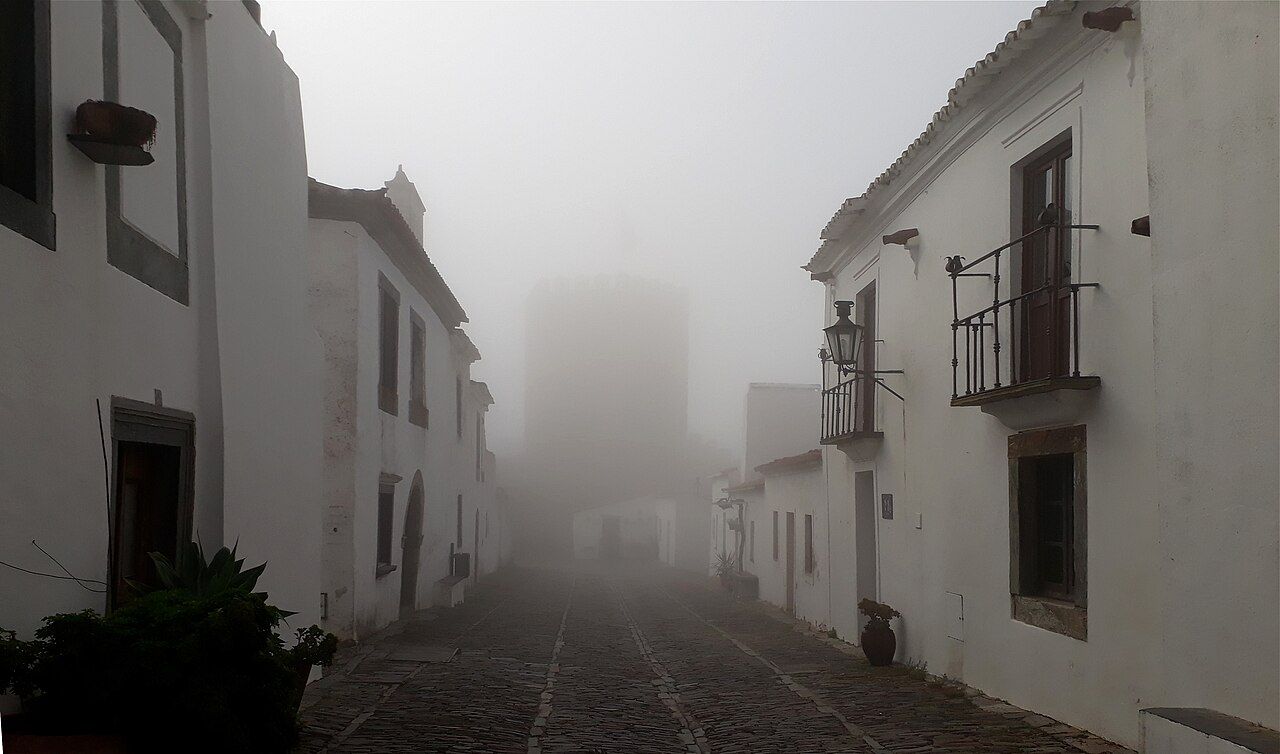
At the highest point stands the castle, much rebuilt over the centuries, with a large cistern and a keep. From its walls you look down on a huge spread of country: the plain of the Alentejo to the south, the hills of the Serra de São Mamede around, and to the east, across the border, the country of Spanish Extremadura. On clear days the view is enormous, and in the evening the light fades slowly across it. The village is often in cloud in winter, which is its own experience.
At the foot of the hill lie the remains of the Roman town of Ammaia, partly excavated. Nearby, Castelo de Vide is a larger, gentler town with an old Jewish quarter and springs, worth a visit on the same day. In autumn, Marvão holds a chestnut festival, a reminder of how important the chestnut trees on these hills once were; dates change, so check before you go.
Monsaraz over the Alqueva
Monsaraz stands on a hill in the south of the Alentejo, close to the Guadiana and the Spanish border. Like Marvão, it is completely walled, with a castle at one end and a few streets of white houses, paved in dark slate, inside. It was taken in the twelfth century during the Christian advance south and later given to military orders to hold against attack. The main street runs from the gate to the church and the castle, past old houses with outside staircases and iron balconies.
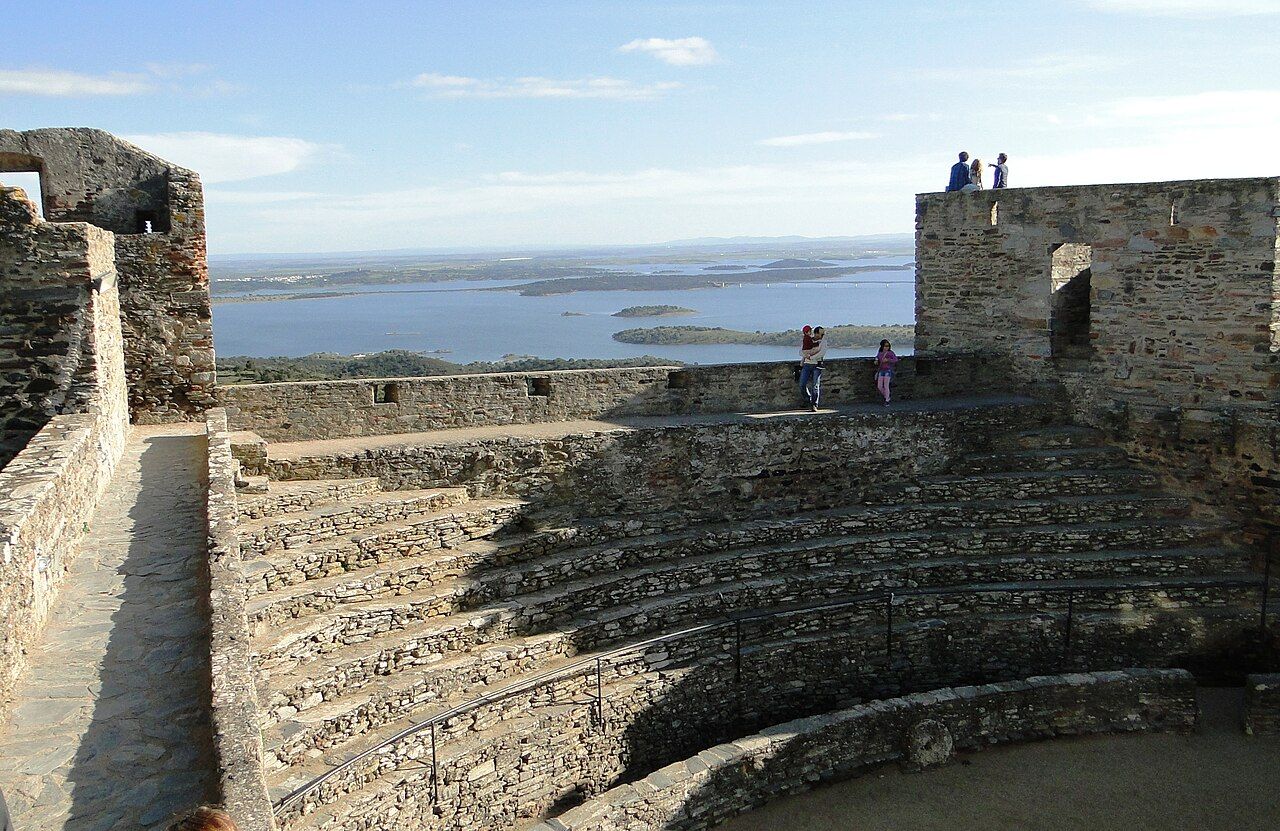
The castle is small and has a remarkable feature: its parade ground has been made into a little bullring, with stone tiers on one side, used for festivals. From the walls, you look down on the waters of the Alqueva, a reservoir created by a dam on the Guadiana and filled from 2002, one of the largest artificial lakes in Europe. Its arms and islands spread across the plain where there were once farms and cork oaks. The old village of Luz was flooded by it and rebuilt nearby.
In a former courthouse near the church, a fifteenth-century fresco shows a good judge and a bad judge, the bad one with two faces, a lesson in civic virtue painted for those who came to court. The country around Monsaraz is also full of prehistoric monuments, standing stones and stone circles, a few of them moved to higher ground when the reservoir was filled.
The night sky over this part of the Alentejo is one of the darkest in Europe, and the area around the lake promotes stargazing. On a clear night from the walls of Monsaraz, with no moon, you see the Milky Way overhead.
What to eat on the frontier
Both villages belong to the Alentejo kitchen, with its bread, olive oil, garlic, coriander and pork, as described in our guide to Évora and the Alentejo plain. The dish to look for is ensopado de borrego, lamb stewed with garlic, bay, wine and olive oil, poured over thick slices of bread in a deep dish, so the bread soaks up the juices. It is a feast dish, and lamb from the hills around is good.
Around Marvão and the Serra de São Mamede, the cooking leans towards the hills, with chestnuts, mushrooms in season, game and pork from the black pig. Around Monsaraz, the plain gives wheat bread and wine: Reguengos de Monsaraz is one of the main wine towns of the Alentejo, with many producers in the area, some still making wine in big clay jars. You also find fish from the reservoir and the river, especially fried or in soups.
In the villages themselves, there are only a few places to eat, and they are busy at lunch. Portuguese lunch starts earlier than in Spain, often from about 12.30 or 1 pm. In the evening, after the day visitors leave, the villages become very quiet. For more on the one-pot cooking of the region, see the inland stew pot.
Quiet evenings and when to come
The best reason to stay overnight in either village is the evening. When the coaches leave, the streets empty, the swallows and swifts circle the towers, the light turns gold on the walls, and the only sounds are bells and the wind. In Marvão, you watch the sun set over the plain from the castle walls; in Monsaraz, over the lake. Mornings are just as quiet, with mist sometimes lying in the valleys below.
Spring is the best time, when the plains are green and full of flowers, and autumn, with chestnuts in Marvão and the harvest around Monsaraz. Summer days are very hot, though evenings on the hilltops are cooler. Winter is cold and often misty, particularly in Marvão, but has its own appeal and few visitors.
Roads along the border
Both villages are best reached by car. Marvão is close to the border crossing towards Valencia de Alcántara and on into Spanish Extremadura, where Cáceres is within a couple of hours. Monsaraz is about an hour from Évora, and from there the road crosses the Guadiana into Spain towards Badajoz and Mérida. The roads up to the villages are steep and narrow, especially to Marvão, and both villages are closed to most traffic inside the walls: park outside the gates and walk in.